What we like
- Short, stimulant-free formula with four named ingredients
- Includes bacopa, which has modest trial evidence for attention and processing speed
- Lion's mane has small early human trials on cognition
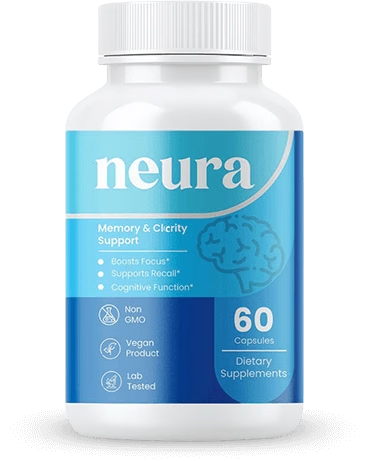
- Bottle label states non-GMO and vegan
- Multi-bottle packages lower the price to $39 to $49 per bottle
Watch out for
- No Supplement Facts panel or ingredient amounts disclosed
- Sales letter relies on an undefined 'dementogen' theory and an unverifiable 'neuroscientist'
- Guarantee described as both 60 and 90 days; refund page favors unopened bottles and excludes return shipping
- Goji and shilajit have little or no human evidence for memory
- Claims of results 'within hours' conflict with how bacopa is studied
- Goji may interact with warfarin
What is Neura?
Neura is a capsule supplement sold as “Neura Supplement” for memory, focus and mental energy. The bottle pictured on the official site reads “Memory & Clarity Support,” holds 60 capsules and carries small badges for “Non GMO,” “Vegan Product” and “Lab Tested.” It is sold only through its own website, with ClickBank acting as the retailer, and the brand says each bottle is a 30-day supply.
The formula is short. The sales materials name four active ingredients: lion’s mane mushroom (Hericium erinaceus), goji berry extract (Lycium barbarum, called “Wolf (Goji) Berry Extract” on the homepage), Bacopa monnieri extract and shilajit extract. That is the whole list we could find. The site does not show a Supplement Facts panel, and none of the pages we reviewed state how many milligrams of any ingredient are in a capsule or a daily serving.
The product’s affiliate page describes the offer as “a brand new, high-converting Memory Supplement Offer” from the creators of several audio programs, and says it is presented by a “Johns Hopkins-trained neuroscientist.” The long-form sales letter is written in the voice of a “Dr. Brian Johnson.” We could not verify who this person is, and the site gives no credentials we could check.
How Neura claims to work
The homepage keeps its language fairly measured: Neura is “formulated to help maintain memory, focus & mental energy,” and the formula is said to work by supporting neurotransmitter balance, protecting nerve tissue from oxidative stress and supporting communication between neurons. It also says “each ingredient is included in researched dosages,” a claim we cannot check because no doses are shown.
The text sales letter goes much further. It describes a “Red Berry Method” and a “3-second” routine, blames memory slips on “dementogens” described as a “parasite-like invader” that “unplugs” brain cells, and credits the formula to the diet of people living at high altitude in Tibet. It says users may “feel the difference within the first few hours,” that the product has “zero reported side effects,” and that “so many doctors recommend Neura to their patients.” “Dementogen” is not an established medical term for a single cause of memory loss, and we found no published research on Neura itself. These are the brand’s claims, not findings.
Two details also lowered our confidence. First, the guarantee is described three ways: 90 days in the homepage footer and on the refund page, but “60 Day” twice in the sales letter FAQ. Second, the refund page says refunds apply to “unopened and undamaged bottles,” with opened bottles handled case by case, and return shipping is not covered. That is narrower than the “no questions asked” wording on the homepage.
What the ingredients actually do
Bacopa monnieri
Bacopa is the best-studied ingredient here. A 2014 meta-analysis of nine randomized trials (518 participants) that used standardized extracts for at least 12 weeks found faster performance on an attention task and shorter reaction times compared with placebo (Kongkeaw et al., 2014). The effects were modest, the trials were small, and they used specific extracts, usually around 300 mg a day, taken for months. Bacopa’s effects build slowly, which conflicts with the sales letter’s “within hours” promise. Read more on our bacopa page.
Lion’s mane
Lion’s mane has small but interesting human trials. In a Japanese trial of 30 older adults with mild cognitive impairment, 3 grams a day of dried mushroom powder for 16 weeks improved scores on a cognitive scale, and scores fell again after people stopped (Mori et al., 2009). A 2023 pilot study in 41 healthy young adults found a slightly quicker result on one attention task an hour after a 1.8 gram dose, but mostly null results over 28 days (Docherty et al., 2023). Both used gram-level amounts. Because Neura’s capsules are standard size and the full formula has four ingredients, it is unlikely each serving provides doses in that range, but without a label we cannot say. See our lion’s mane page.
Goji berry
The brain claims for goji rest mainly on animal and cell studies of its polysaccharides. Human research is thin: a 14-day trial of 34 adults drinking a commercial goji juice reported better self-rated energy, focus and mood, but it was small, short, relied on questionnaires and came from the juice maker (Amagase and Nance, 2008). A better-designed pilot trial found eating 28 grams of whole goji berries five times a week raised macular pigment, which relates to eye health rather than memory (Li et al., 2021). Goji has also been linked to bleeding in people taking warfarin (Rivera et al., 2012). More on our new goji berry page.
Shilajit
Shilajit is a mineral-rich resin used in Ayurveda. A review noted that “relatively few well-controlled human studies” exist and that most data come from animal and lab work (Stohs, 2014). Small trials have looked at testosterone and bone density, not memory. The sales letter cites a 2023 paper proposing shilajit as a neuroprotective agent, but we found no controlled trial in people showing that shilajit improves memory. Raw or poorly processed shilajit can contain heavy metals, so purity testing matters; the sales letter says the product is tested, but no certificate of analysis is posted. See our shilajit page.
In short, one ingredient (bacopa) has modest evidence for attention, one (lion’s mane) has small early trials, and two have little or no human evidence for memory. Without doses, it is impossible to tell whether Neura provides the amounts used in those studies.
Who it may suit, and who should skip it
Neura may appeal to adults who want a simple, stimulant-free formula built around bacopa and lion’s mane and who accept that the amounts are unknown. If everyday forgetfulness is the concern, it is worth starting with the basics covered in our guides to everyday forgetfulness and brain fog and memory changes as you get older: sleep, physical activity, hearing and vision checks, and a review of medications that can dull thinking.
Skip Neura, or talk with a doctor first, if you take warfarin or another blood thinner (goji), thyroid medication or sedatives (bacopa may interact with some medications), diabetes medication, or if you are pregnant or breastfeeding, since safety data are lacking. Memory changes that are new, worsening or noticed by family deserve a medical evaluation rather than a supplement trial. For broader options, see our brain and focus hub.
Price, guarantee and where to buy
Neura is sold only on its official website. At the time of our review, one bottle cost $59 plus $4.95 shipping, three bottles cost $147 ($49 each) and six bottles cost $234 ($39 each), with free shipping and bonus gifts on the larger packages. The homepage and refund page describe a 90-day money-back guarantee counted from delivery, but the refund page limits refunds to unopened bottles except in specific cases, asks you to contact support first and does not cover return shipping. Keep your packaging and proof of purchase, and read the terms before buying multiple bottles.
Our verdict
Neura’s four ingredients are reasonable choices on paper, and bacopa in particular has modest support for attention. But the brand discloses no doses, relies on a sales letter built around an undefined “dementogen” theory and an unverifiable expert, and gives conflicting guarantee terms with a refund policy that favors unopened bottles. We rate it 2.4 out of 5. If you want to try bacopa or lion’s mane, a single-ingredient product with a clear label lets you match the amounts used in research. Compare alternatives in our best brain and focus supplements guide.
Ingredients and the evidence behind them
| Ingredient | Amount | Why it’s included | Evidence |
|---|---|---|---|
| Bacopa Monnieri | Not disclosed | Main memory and attention ingredient; standardized extracts have modest trial evidence for processing speed after 12 weeks or more. | Moderate |
| Lion's Mane | Not disclosed | Included for focus and nerve health; small human trials used gram-level doses with mixed results. | Preliminary |
| Goji Berry | Not disclosed | Marketed as a 'neuroprotectant'; evidence for brain effects comes mainly from animal studies, with small human trials on well-being and eye health. | Preliminary |
| Shilajit | Not disclosed | Mineral resin promoted for energy and brain protection; few controlled human studies and none on memory. | Preliminary |
Each ingredient links to its own page with the research, typical doses and safety notes.
Side effects and who should avoid it
Because Neura does not disclose ingredient amounts, side effects are hard to predict. Bacopa commonly causes stomach upset, nausea, cramps and loose stools in trials, and it may interact with some medications, including sedatives. Lion’s mane is usually well tolerated but can cause stomach discomfort or allergic reactions, especially in people allergic to mushrooms. Goji has been linked to dangerous rises in INR and bleeding in people taking warfarin. Shilajit products can be contaminated with heavy metals if poorly purified. Avoid Neura during pregnancy or breastfeeding, and talk with your doctor before use if you take blood thinners, diabetes medication, thyroid medication or sedatives, or if memory changes are new or getting worse.
FAQ
What ingredients are in Neura?
The sales pages name four: lion's mane mushroom, goji berry extract, Bacopa monnieri extract and shilajit extract. No Supplement Facts panel or amounts are shown, so we cannot say how much of each you get per serving.
Does Neura work for memory?
There are no published studies on Neura itself. Bacopa has modest evidence for attention after about 12 weeks of standardized extract, and lion's mane has small early trials. Goji and shilajit have little human evidence for memory. Without doses, we cannot tell whether Neura matches the amounts used in research.
Will I notice Neura working within hours?
The sales letter says many users feel a difference within hours, but bacopa trials measured effects after 12 weeks or more. Quick, dramatic changes are not what the research on these ingredients shows.
Is Neura safe with blood thinners?
Use caution. Goji berry has been linked in case reports to bleeding and very high INR in people taking warfarin. Talk with your doctor before taking Neura if you use any blood thinner.
What is Neura's refund policy?
The homepage and refund page describe a 90-day money-back guarantee, while the sales letter also mentions 60 days. The refund page says refunds apply to unopened, undamaged bottles, with opened bottles handled case by case, and return shipping is not covered.
Where can I buy Neura?
The brand says Neura is sold only on its official website, with ClickBank processing orders. It is not sold through Amazon or retail stores according to the vendor.
Sources
- Official Neura website. Product details, label and pricing
- Meta-analysis of randomized controlled trials on cognitive effects of Bacopa monnieri extract. J Ethnopharmacol, 2014
- A randomized, double-blind, placebo-controlled, clinical study of the general effects of a standardized Lycium barbarum (Goji) Juice, GoChi. J Altern Complement Med, 2008
- Goji Berry Intake Increases Macular Pigment Optical Density in Healthy Adults: A Randomized Pilot Trial. Nutrients, 2021
- Improving effects of the mushroom Yamabushitake (Hericium erinaceus) on mild cognitive impairment: a double-blind placebo-controlled clinical trial. Phytother Res, 2009