What we like
- Full Supplement Facts panel with every ingredient amount
- Includes pygeum and beta-sitosterol, both supported by Cochrane reviews for short-term symptom relief
- Pumpkin seed oil dose is close to a published trial
- 180-day money-back guarantee, even on empty bottles, per the brand
- Six-bottle kit brings the price down to $39 per bottle
Watch out for
- Sales page relies on a "urethra strengthening" theory and Johns Hopkins research we could not find
- Lycopene (about 1.9 mg) and broccoli sprout extract are present at token doses
- Beta-sitosterol is listed as a 30 mg complex without the pure sterol content
- Gelatin capsules are not vegetarian
- Shipping adds $9.95 on one- and three-bottle orders, and the page shows two different single-bottle prices
What is TitanFlow?
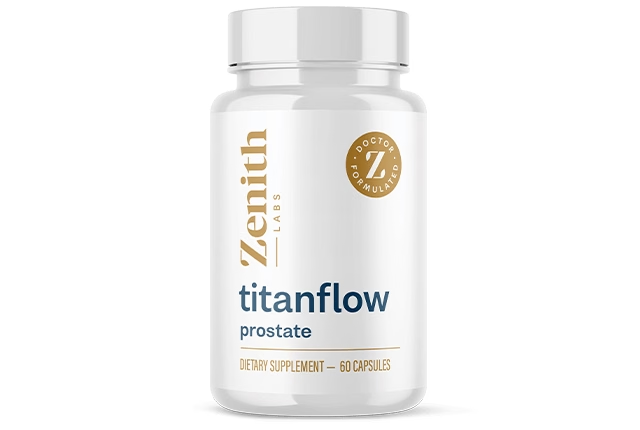
TitanFlow is a prostate and urinary flow capsule from Zenith Labs, a Colorado-based supplement company that sells through ClickBank. It is aimed at men over 40 who notice a weaker stream, incomplete emptying or frequent trips to the bathroom. Each bottle contains 60 capsules, and the suggested serving is two capsules once a day, so one bottle lasts 30 days.
TitanFlow is one of the more transparent products in its category. The sales page shows a full Supplement Facts panel with five ingredients and their amounts per two-capsule serving: pumpkin seed oil 500 mg, lycopene 5% from tomato 37.5 mg, broccoli sprout extract 4:1 50 mg, a beta-sitosterol complex 30 mg and pygeum bark extract 4:1 100 mg. Other ingredients are rice flour, silicon dioxide, vegetable-grade magnesium stearate and a gelatin capsule, so it is not vegetarian. The FAQ says it is produced in an FDA-inspected US facility and undergoes independent testing.
How TitanFlow claims to work
The sales page is presented by Dr. Ryan Shelton, a naturopathic physician affiliated with Zenith Labs. Its central idea is that weak urinary flow is not only about prostate size but about the strength of the urethra wall, and that “new Johns Hopkins research” shows about half of men over 40 have urethras that lose the strength to resist pressure. It claims TitanFlow is the first formula in the world to target urethral wall strength, and that pumpkin seed oil strengthened urethra walls and improved flow measures by more than 20%.
We could not find the Johns Hopkins study the page describes, and the page does not cite it. We also found no published human research showing that any of these ingredients “strengthen urethra walls.” The ingredients themselves, however, are classic prostate-support botanicals that have been tested in men with lower urinary tract symptoms linked to an enlarged prostate. So the marketing story is new, but the formula is conventional.
What the ingredients actually do
Pygeum: the best-supported ingredient
Pygeum is an extract of African cherry tree bark. A Cochrane review of 18 randomized trials with 1,562 men found that, compared with placebo, men taking pygeum were about twice as likely to report overall symptom improvement, with nocturia reduced by 19%, leftover urine volume by 24% and peak flow increased by 23%. Side effects were mild and similar to placebo. The reviewers cautioned that the trials were small, short (about two months on average) and used varied doses and preparations (Wilt et al., 2002). TitanFlow provides 100 mg of a 4:1 extract. See our pygeum page.
Beta-sitosterol
Beta-sitosterol is a plant sterol. A Cochrane review of four trials with 519 men found it improved symptom scores by about 4.9 points on the International Prostate Symptom Score and raised peak flow by about 3.9 mL per second compared with placebo, without shrinking the prostate. Long-term effectiveness and safety are unknown, and the trials used several different preparations (Wilt et al., 2000). TitanFlow lists 30 mg of a “beta sitosterol complex” without saying how much is pure beta-sitosterol, so it is hard to match to those trials. More on our beta-sitosterol page.
Pumpkin seed oil
In a Korean placebo-controlled trial, 47 men with symptomatic enlarged prostate took 320 mg a day of pumpkin seed oil, saw palmetto oil, both, or placebo for a year. Symptom scores improved from baseline in the treatment groups, and maximal flow improved significantly after six months in the pumpkin seed oil group (Hong et al., 2009). The much larger German GRANU trial in 1,431 men found that whole pumpkin seed (5 grams twice a day) produced a clinically relevant symptom benefit, while a pumpkin seed extract capsule did not beat placebo; the authors said the findings need confirmation (Vahlensieck et al., 2015). TitanFlow’s 500 mg of oil is in the range of the smaller study. See our pumpkin seed oil page.
Lycopene and broccoli sprout
Lycopene is the red carotenoid in tomatoes. A systematic review of eight trials could neither support nor refute lycopene for preventing or treating prostate enlargement (Ilic and Misso, 2012). At 37.5 mg of a 5% extract, TitanFlow supplies only about 1.9 mg of lycopene, far less than the 25 mg a day used in a recent trial in men with enlarged prostate, which itself found no significant benefit over placebo for lycopene alone (Sadeghi et al., 2022). Broccoli sprout extract supplies glucoraphanin, the precursor of sulforaphane, which has been studied for blood sugar and liver markers (Dwibedi et al., 2025) but not for urinary flow. These two look like supporting antioxidants rather than active doses. See lycopene and broccoli sprout extract.
Who it may suit, and who should skip it
TitanFlow may suit men with mild, already-diagnosed urinary symptoms from an enlarged prostate who want to try a botanical approach with a clearly labeled formula. Its two strongest ingredients, pygeum and beta-sitosterol, have reasonable short-term evidence, though trials are older and small. It does not include saw palmetto, which NCCIH says is probably not helpful for these symptoms based on many studies (NCCIH); our post on saw palmetto’s big trials explains that research.
Urinary symptoms should be checked by a doctor before you self-treat, because they can also come from infection, bladder problems, diabetes, medicines or, less commonly, prostate cancer. Our pages on a weak urine stream after 50, waking up at night to urinate and prostate checkups and PSA questions cover what to expect. See a doctor promptly for blood in the urine, pain, fever or being unable to urinate.
Talk to your doctor before taking TitanFlow if you already use prostate medicines such as alpha-blockers or 5-alpha-reductase inhibitors, take blood thinners, are being monitored with PSA tests, or have a hormone-sensitive condition. The capsules contain gelatin, so they are not suitable for vegetarians, and the product is not intended for women or anyone under 18.
Price, guarantee and where to buy
On the order section of the official sales page at the time of our review, one bottle cost $69 plus $9.95 US shipping, three bottles cost $177 ($59 each) plus $9.95 shipping, and six bottles cost $234 ($39 each) with free US shipping. An earlier paragraph on the same page mentions a $59 single-bottle price, so check the checkout total before paying. The brand describes it as a one-time payment with no subscription. TitanFlow is covered by a 180-day money-back guarantee that the brand says applies even if you have used all of the bottles. Buy only from the official site, where ClickBank processes the order.
Our verdict
TitanFlow is a better-than-average prostate formula hidden behind an overstated sales pitch. The full label is a real plus, pygeum and beta-sitosterol have Cochrane-reviewed evidence for modest short-term symptom relief, and the pumpkin seed oil dose is close to a published trial. On the other hand, the “urethra strengthening” story and the Johns Hopkins framing are not backed by any study we could find, lycopene and broccoli sprout are present at token amounts, and the beta-sitosterol content is unclear. A 180-day guarantee and fair multi-bottle pricing make it a low-risk trial for men whose symptoms have been checked by a doctor. We rate it 3.3 out of 5.
Ingredients and the evidence behind them
| Ingredient | Amount | Why it’s included | Evidence |
|---|---|---|---|
| Pumpkin Seed Oil | 500 mg | Lead ingredient; the brand says it strengthens the urethra wall and supports flow. Studied for urinary symptoms linked to an enlarged prostate. | Limited |
| Lycopene | 37.5 mg of a 5% extract (about 1.9 mg lycopene) | Antioxidant said to protect cells lining the urethra; present at a low dose. | Limited |
| Broccoli Sprout Extract | 50 mg (4:1 extract) | Antioxidant support; the brand says it helps fortify urethra walls and flush toxins, which has not been studied. | Preliminary |
| Beta-Sitosterol | 30 mg (beta sitosterol complex; pure beta-sitosterol content not stated) | Supports complete bladder emptying and flow, per the brand; one of the better-studied ingredients for enlarged-prostate symptoms. | Moderate |
| Pygeum | 100 mg (4:1 bark extract) | Herbal extract said to relax smooth muscle and improve flow; the best-studied ingredient in the formula. | Moderate |
Each ingredient links to its own page with the research, typical doses and safety notes.
Side effects and who should avoid it
The ingredients are generally well tolerated in studies. The most common complaints with pygeum, beta-sitosterol and pumpkin seed oil are mild digestive symptoms such as nausea, stomach upset or diarrhea. Broccoli sprout extract can cause gas or bloating. Lycopene may lower PSA slightly, which could affect how PSA tests are interpreted. Talk to your doctor before use if you take prostate medicines (alpha-blockers or 5-alpha-reductase inhibitors), blood thinners, diuretics or cholesterol drugs, or have a thyroid condition. The label says it is not for anyone under 18 or for pregnant or nursing women. Urinary symptoms should always be evaluated by a doctor, and blood in the urine, pain, fever or inability to urinate need prompt care.
FAQ
Does TitanFlow work?
There are no published studies on TitanFlow itself. Two of its ingredients, pygeum and beta-sitosterol, improved urinary symptoms and flow modestly in short trials summarized by Cochrane reviews, and pumpkin seed oil has smaller supporting studies. There is no evidence that it strengthens the urethra wall, as the sales page claims.
What is in TitanFlow?
Each two-capsule serving contains pumpkin seed oil 500 mg, lycopene 5% (tomato) 37.5 mg, broccoli sprout extract 4:1 50 mg, beta sitosterol complex 30 mg and pygeum bark extract 4:1 100 mg, in a gelatin capsule.
Can I take TitanFlow with prostate medication?
Ask your doctor first. There are no interaction studies with alpha-blockers or 5-alpha-reductase inhibitors, and lycopene may slightly lower PSA, which matters if your PSA is being monitored.
Does TitanFlow contain saw palmetto?
No. TitanFlow does not list saw palmetto. NCCIH concludes that saw palmetto is probably not helpful for urinary symptoms of an enlarged prostate, so its absence is not a drawback.
How much does TitanFlow cost?
At the time of our review, the order section listed $69 for one bottle and $177 for three, each plus $9.95 US shipping, and $234 for six with free US shipping. It is backed by a 180-day money-back guarantee.
Sources
- Official TitanFlow website. Product details, label and pricing
- Pygeum africanum for benign prostatic hyperplasia. Cochrane Database Syst Rev, 2002
- Beta-sitosterols for benign prostatic hyperplasia. Cochrane Database Syst Rev, 2000
- beta-sitosterol for the treatment of benign prostatic hyperplasia: a systematic review. BJU Int, 1999
- Effects of pumpkin seed in men with lower urinary tract symptoms due to benign prostatic hyperplasia in the one-year, randomized, placebo-controlled GRANU study. Urol Int, 2015