What we like
- Full ingredient list printed on the label
- Contains undecylenic acid, an established topical antifungal, and tea tree oil, which has one randomized toenail trial
- Applied to the nail, so systemic drug interactions are unlikely
- Clear label directions, including filing the nail to help absorption
Watch out for
- No published studies of Kerassentials itself
- Undecylenic acid is 5%, below the 10 to 25% range in FDA's over-the-counter antifungal rules
- Only one ingredient concentration is disclosed; mineral oil is the second ingredient despite 'no chemicals' marketing
- Claims of fungus-free nails go well beyond the evidence
- Expensive for a 15 ml bottle that is applied four times a day
- 60-day refund counted from delivery, all bottles must be returned and return shipping is not covered
What is Kerassentials?
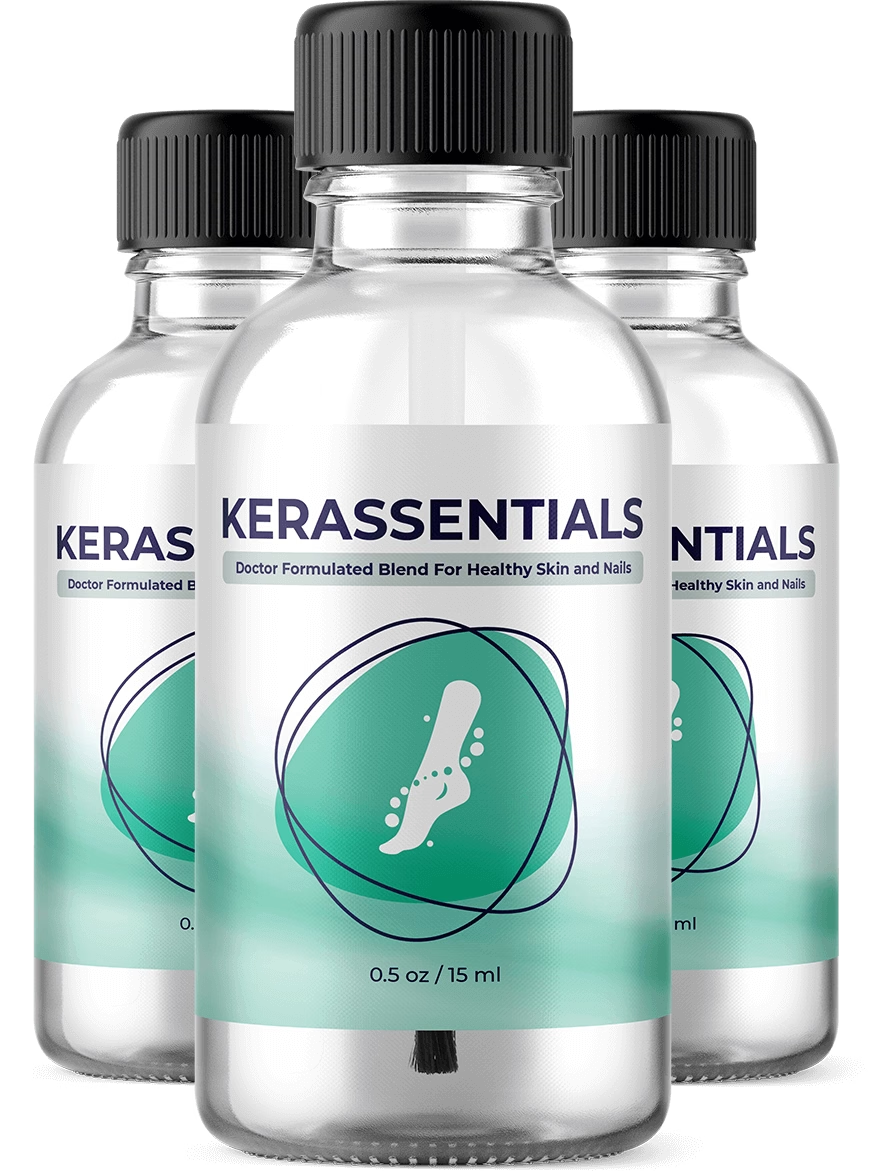
Kerassentials is a topical oil sold online for the look of toenails and the skin around them. It is not a supplement you swallow. The label says “for external use only,” warns against contact with the eyes, and says to drink water and seek medical attention if it is swallowed. Each bottle holds 0.5 oz (15 ml) and comes with an applicator. The label describes it as a “Doctor Formulated Blend For Healthy Skin and Nails” and lists Kerassentials, of Aurora, Colorado, as the distributor (Kerassentials label). The sales page shows badges for GMP certification, an FDA-registered facility, GMO-free ingredients and US manufacturing.

The marketing targets toenail fungus directly. It talks about oils that “fight fungus resistance,” a “fungus-free life” and “flawless nails.” Nail fungus, called onychomycosis, is a medical condition. Kerassentials is not an FDA-approved nail fungus treatment and has no published trials showing it clears nail fungus. We analyzed the label and the research on its ingredients; we did not test the product.
How Kerassentials claims to work
The sales page says the formula supports “healthy nails and skin,” and its FAQ says that “within the first weeks you should be noticing new healthy pink nails growing out to replace the damaged areas.” The FAQ on the contact page goes further, saying the clove bud oil “will make sure the fungus can’t multiply” and that undecylenic acid “will make the fungus self-destruct.” Those are strong claims for a product that has not been studied.
The ingredient list, in label order, is undecylenic acid USP (5%), mineral oil, sweet almond oil, organic flaxseed oil, tea tree oil, aloe vera leaf extract, canola oil, tocopheryl acetate (vitamin E), walnut oil, menthol, camphor oil, clove bud oil, jojoba oil, chia oil, lemongrass oil, lavender oil and manuka oil. Only undecylenic acid has a stated concentration. Mineral oil is the second ingredient, which sits oddly beside the page’s “plant ingredients” and “no chemicals” badges.
The directions also differ. The label says to apply it four times a day, twice in the morning and twice in the afternoon, coating the nail with the applicator, working it into the cuticle with a cotton swab and filing the nail surface with an emery board so the oil absorbs better. The FAQ describes applying it after you shower.
What the ingredients actually do
Context matters here, because toenail fungus is hard to clear even with medicine. MedlinePlus says over-the-counter creams and ointments usually do not help, that prescription oral antifungals taken for two to three months clear the fungus in about half of people, that a new clear nail can take up to a year to grow, and that the infection may return (MedlinePlus). A 2020 Cochrane review of 56 trials with 12,501 people found that prescription topical solutions such as efinaconazole 10% and tavaborole 5% outperformed a placebo vehicle for complete cure, typically after about 48 weeks of daily use (Foley et al., 2020). That is the bar any nail product has to clear.
Undecylenic acid
This fatty acid, made from castor oil, is a genuine antifungal. FDA’s over-the-counter rules for topical antifungal products allow undecylenic acid and its salts at a total undecylenate concentration of 10 to 25 percent (21 CFR 333.210). Kerassentials lists 5%, below that range. Older controlled trials in athlete’s foot found undecylenic acid powder cured 53% of patients versus 7% with talc or no treatment (Smith et al., 1977), and an ointment performed similarly to tolnaftate (Fuerst et al., 1980). Those were skin infections, not thick toenails. We found no controlled trials of undecylenic acid alone for toenail fungus. More on our undecylenic acid page.
Tea tree oil
The best-known human study is a 1994 randomized trial in 117 people with confirmed toenail fungus. Pure (100%) tea tree oil applied twice daily for six months produced a culture cure in 18%, compared with 11% for 1% clotrimazole, and about 60% in both groups had partial or full improvement in appearance (Buck et al., 1994). NCCIH says only a few studies have looked at tea tree oil for nail infections and that the evidence is insufficient to draw conclusions (NCCIH). Kerassentials does not say how much tea tree oil it contains. See our tea tree oil page.
Clove, lemongrass, lavender and manuka oils
These essential oils show antifungal activity in lab dishes. Clove oil inhibited the spores and growth of several skin fungi (Chee and Lee, 2007), lemongrass oil was among the most active of 13 oils against dermatophyte strains (Lima et al., 1993), lavender oil reduced Candida yeast counts (Behmanesh et al., 2015), and manuka oil showed antifungal activity weaker than tea tree oil (Lis-Balchin et al., 2000). Lab results do not show that an oil penetrates a thick nail plate or clears infection in people.
Menthol and camphor
These are the main ingredients of mentholated chest rubs. In an 18-person case series without a control group, people applying Vicks VapoRub to infected toenails for 48 weeks saw 5 (27.8%) reach both clinical and laboratory cure (Derby et al., 2011). The American Academy of Dermatology says small studies of tea tree oil and mentholated ointments suggest there may be some benefit, but that we still do not know how effective they are or what side effects could occur (AAD).
Vitamin E and carrier oils
An open study of 20 people using a different nail oil, made with vitamin E and essential oils of lime, oregano and tea tree, reported complete cure in most participants after a year (Alessandrini et al., 2020). It had no control group and tested another formula, so it cannot be applied to Kerassentials. Sweet almond, jojoba, flaxseed, walnut, canola and chia oils, along with aloe, mainly soften and moisturize skin (Blaak and Staib, 2022). That can make nails and cuticles look healthier, but moisturizing is not the same as treating an infection.
Who it may suit, and who should skip it
Kerassentials may suit an adult with otherwise healthy feet who wants a moisturizing nail and cuticle oil, ideally after a clinician has looked at the nail, and who understands that its antifungal evidence is limited. If a dermatologist or podiatrist confirms nail fungus, ask about prescription topical or oral treatments first, since those are the options with trial evidence. Our guide to thick, discolored toenails explains what to expect.
See a clinician before relying on any nail oil if:
- You have diabetes, poor circulation or numbness in your feet. In a study of more than 48,000 people with diabetes, those with nail fungus had a higher risk of foot ulcers, skin infections and foot surgery (Watjer et al., 2024). Foot problems in diabetes need professional care.
- The nail or skin is painful, red, swollen or draining pus, or the problem is spreading to other nails or skin (MedlinePlus).
- You are not sure it is fungus. Nail psoriasis and nail injuries can look like nail fungus, and a lab test of a nail sample confirms the diagnosis (AAD).
- You have a weakened immune system. MedlinePlus lists immune problems as a risk factor for fungal nail infection (MedlinePlus).
Also use caution if you are allergic to tree nuts, since the oil contains sweet almond and walnut oils, or if you react to fragrances or essential oils. Tea tree oil has caused more published allergic skin reactions than any other essential oil (de Groot and Schmidt, 2016). Because Kerassentials is applied to the nail rather than swallowed, interactions with blood thinners, diabetes medicines or sedatives are not expected, but it must be kept away from children and pets, as essential oils such as tea tree oil can be dangerous if swallowed (NCCIH). If you are pregnant or breastfeeding, the vendor’s own disclaimer says to consult your physician first.
Price, guarantee and where to buy
Kerassentials is sold through its official site, with checkout handled by ClickBank. The order page showed three packages: two bottles at $79 each plus $9.99 shipping, a “2 + 1” offer of three bottles at $69 each with free shipping, and a “3 + 3” offer of six bottles at $49 each with free shipping and three bonus e-books. That works out to about $158, $207 and $294 before any tax. The page does not state in its text how many days one bottle lasts; at four applications a day, a 15 ml bottle may not last long if several nails are involved.
The guarantee is 60 days. The refund policy counts the 60 days from delivery, requires you to email support and send back all bottles, opened or not, and says the company does not cover return shipping (refund policy). The same policy asks customers to use the product for at least three months before deciding, which is longer than the refund window. Since a new toenail takes many months to grow out, 60 days is not enough time to judge results.
Our verdict
Kerassentials combines a real but low-strength antifungal, undecylenic acid at 5%, with tea tree oil and other essential oils that have lab data and a few small human studies, in a mineral oil and plant oil base. That makes it a reasonable-sounding nail oil, but not a proven nail fungus treatment, and the sales claims go well beyond the evidence.
Our score of 2.6 out of 5 reflects limited ingredient evidence for toenail fungus (the factor we weight most), a label that names every ingredient but gives only one concentration, a price of $49 to $79 per small bottle, and a short 60-day refund window with return shipping at your cost. If your toenails are thick, discolored or crumbling, have a dermatologist or podiatrist confirm the cause, especially if you have diabetes, pain or spreading changes.
Ingredients and the evidence behind them
| Ingredient | Amount | Why it’s included | Evidence |
|---|---|---|---|
| Undecylenic acid USP (5%) | 5% of the formula (the only concentration on the label) | Main antifungal ingredient | Moderate |
| Tea tree oil | Undisclosed | Antifungal essential oil | Limited |
| Clove bud oil | Undisclosed | Antifungal essential oil; the brand says it stops fungus from multiplying | Preliminary |
| Lavender oil | Undisclosed | Essential oil the brand says protects nail keratin and fights fungus | Preliminary |
| Lemongrass oil | Undisclosed | Antifungal and fragrance essential oil | Preliminary |
| Manuka oil | Undisclosed | Antifungal essential oil marketed as stronger than tea tree oil | Preliminary |
| Sweet almond oil | Undisclosed (third ingredient on the label) | Moisturizing carrier oil | Limited |
| Jojoba oil | Undisclosed | Moisturizing, stable carrier | Limited |
| Menthol | Undisclosed | Cooling agent, paired with camphor as in mentholated rubs | Preliminary |
| Organic flaxseed oil | Undisclosed (fourth ingredient on the label) | Carrier oil the brand says supports skin immunity; mainly moisturizing | Limited |
| Aloe vera leaf extract | Undisclosed | Soothing, moisturizing skin ingredient | Limited |
| Tocopheryl acetate (vitamin E) | Undisclosed | Antioxidant and skin conditioning ingredient | Preliminary |
Each ingredient links to its own page with the research, typical doses and safety notes.
Side effects and who should avoid it
As a topical oil, Kerassentials is unlikely to cause whole-body side effects, but skin reactions are possible. Tea tree oil is the essential oil most often reported to cause allergic contact dermatitis, and oxidized (old or air-exposed) oil is more likely to do so. Clove, lavender, lemongrass, camphor and menthol can also irritate or sensitize skin, and the oil contains sweet almond and walnut oils, a concern for people with tree nut allergies. Stop using it if you notice redness, itching, burning or a rash, and test it on a small area first. It must not be swallowed: tea tree oil and camphor can be dangerous by mouth, so keep it away from children and pets. People with diabetes, poor circulation, a weakened immune system, or those who are pregnant or breastfeeding should talk to a doctor before treating foot or nail problems at home.
FAQ
Does Kerassentials cure toenail fungus?
There is no evidence that it does. Kerassentials has not been tested in published studies. Some of its ingredients, such as undecylenic acid and tea tree oil, have antifungal activity, but the human evidence for toenails is limited, and a dermatologist or podiatrist should confirm and treat nail fungus.
Is Kerassentials a supplement?
No. It is a topical oil applied to the nails and cuticles. The label says it is for external use only and should not be swallowed.
How do you use Kerassentials?
The label says to apply it four times a day, twice in the morning and twice in the afternoon, using the applicator on the nail and a cotton swab on the cuticle, and to file the nail surface gently so the oil absorbs better.
How long does it take to see results on toenails?
Toenails grow slowly. MedlinePlus notes that even when nail fungus treatment works, a new clear nail can take up to a year to grow. That is much longer than the 60-day refund window.
What is the Kerassentials refund policy?
There is a 60-day money-back guarantee counted from delivery. You email support, return all bottles whether opened or not, and pay the return shipping yourself.
Should I see a doctor instead?
Yes, if the nail is painful, red or draining, the change is spreading, you are not sure it is fungus, or you have diabetes, poor circulation or a weakened immune system. Prescription treatments have much stronger evidence than over-the-counter oils.
Sources
- Official Kerassentials website. Product details, label and pricing
- Topical and device-based treatments for fungal infections of the toenails. Cochrane Database Syst Rev, 2020
- Topical undecylenic acid in tinea pedis: a new look. Int J Dermatol, 1977
- Comparison between undecylenic acid and tolnaftate in the treatment of tinea pedis. Cutis, 1980
- Comparison of two topical preparations for the treatment of onychomycosis: Melaleuca alternifolia (tea tree) oil and clotrimazole. J Fam Pract, 1994