What we like
- Full Supplement Facts panel with every ingredient amount
- Bilberry (480 mg) and saffron (20 mg) doses match amounts used in randomized trials
- Includes lutein and zeaxanthin, the best-studied eye carotenoids
- Copper is balanced with zinc, a sensible formulation detail
- 180-day money-back guarantee badge on the order page
Watch out for
- Marketed as an "AREDs-2" formula, but zinc and vitamin E doses are far below NEI's AREDS 2 amounts
- Headline ingredient ginkgo has weak evidence for eye health and is used as leaf powder, not a standardized extract
- Affiliate emails claim to restore 20/20 vision and combat macular degeneration, which is unsupported
- Turmeric with black pepper and ginkgo raise interaction concerns for people on blood thinners
- Single bottle carries a $9.99 shipping fee
What is iGenics?
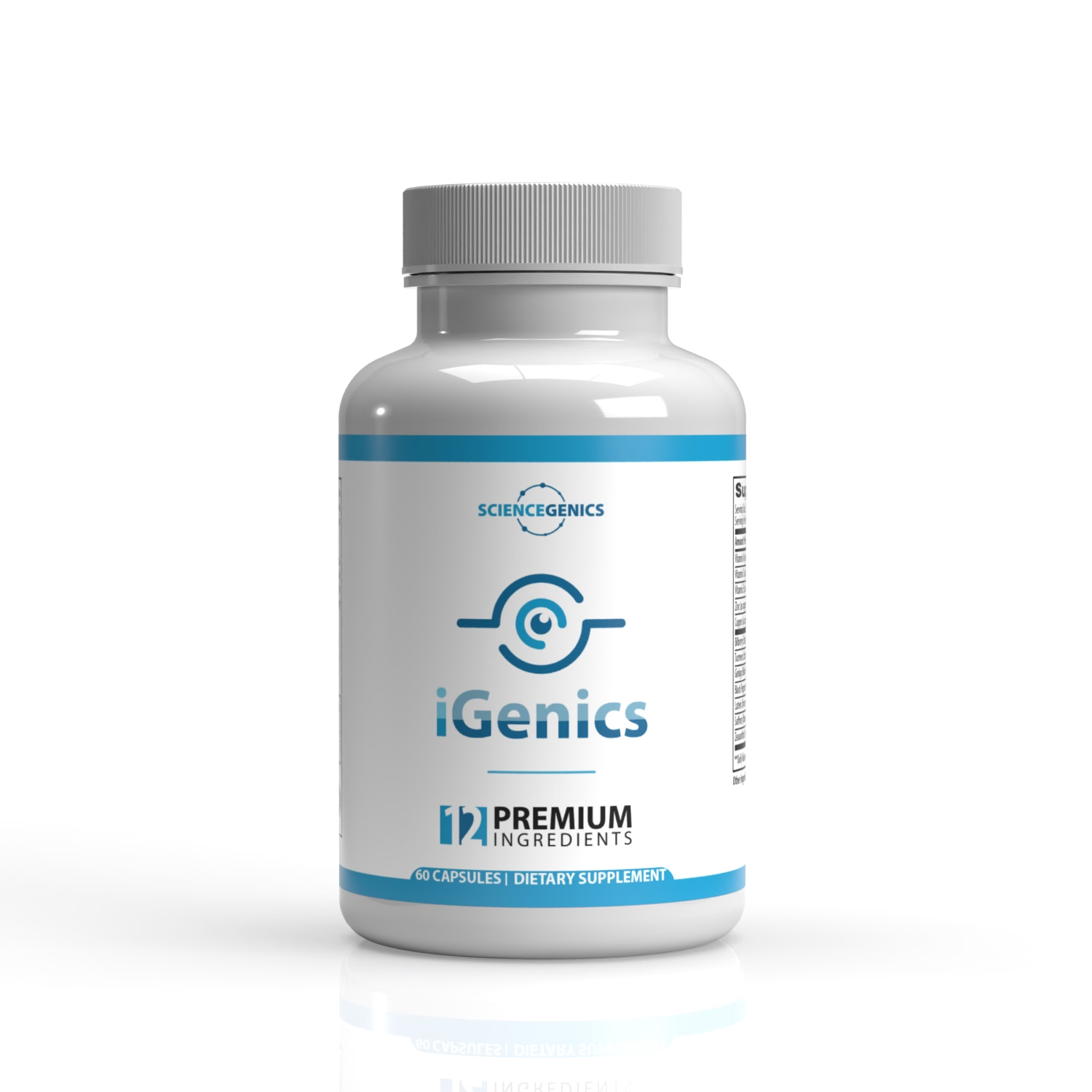
iGenics is a capsule supplement sold online as a plant-based vision support formula. It is made by a company called ScienceGenics, sold through ClickBank, and shipped from a return address in Tallmadge, Ohio. Each bottle holds 60 vegetable capsules. The serving is 2 capsules, so one bottle is a 30-day supply. The bottle front says “12 Premium Ingredients,” and the sales page says the formula is vegan, contains no fillers, is made in a GMP certified facility in the US and uses third-party tested ingredients.
Unlike many online eye supplements, iGenics publishes a full Supplement Facts panel with the amount of every ingredient. That is a real point in its favor, because it lets us compare the doses with published research. We analyzed the label, the sales page, the affiliate materials and the studies behind each ingredient. We did not test the product on people.
How iGenics claims to work
The brand says iGenics “unites 12 clinically-backed ingredients that support healthier eyesight” and that it is designed to support clearer vision “by maintaining a healthy inflammatory response.” The sales page calls ginkgo biloba the main ingredient and says it is combined with “vision restoring AREDs-2 ingredients,” bilberry, saffron, and turmeric with black pepper extract.
Two parts of that pitch deserve a closer look. First, “AREDS-2” refers to a specific formula tested by the National Eye Institute for people who already have intermediate age-related macular degeneration (AMD). It is not a general vision booster, and the NEI says it does not stop early AMD from progressing. Second, iGenics only partly matches that formula. It provides the same 500 mg of vitamin C and 2 mg of copper, but only 20 mg of zinc instead of 80 mg, a much smaller amount of vitamin E than the 400 IU used in AREDS 2, and twice the lutein (20 mg vs. 10 mg) and five times the zeaxanthin (10 mg vs. 2 mg). It also adds 900 mcg of preformed vitamin A, which is not part of AREDS 2. So calling it an “AREDs-2 formula” is a stretch.
The affiliate page, which gives promoters ready-made emails, goes much further than the sales page. Those swipes promise to “restore your 20/20 eyesight naturally,” describe a “12-second eye trick” and claim to combat macular degeneration. No supplement has been shown to do any of that, and we would treat any ad that uses this language with suspicion.
What the ingredients actually do
Here is what each dose looks like next to the evidence, starting with the ingredients that matter most.
Lutein (20 mg) and zeaxanthin (10 mg)
These two carotenoids form the macular pigment at the center of the retina. In AREDS2, adding 10 mg lutein and 2 mg zeaxanthin to the AREDS formula did not significantly slow progression to advanced AMD in the primary analysis, but it became the preferred replacement for beta-carotene. Smaller trials consistently show that lutein and zeaxanthin raise macular pigment density, and a 2024 network meta-analysis found modest gains in contrast sensitivity. The iGenics doses are on the high side of what has been studied. This is the best-supported part of the formula, though benefits for people with healthy eyes remain uncertain.
Bilberry extract (480 mg)
Bilberry is the most interesting dose on the label. A randomized, placebo-controlled Japanese trial gave office workers 480 mg per day of bilberry extract for 8 weeks and found that some objective and subjective measures of eye fatigue after screen work improved compared with placebo. That is the same daily amount iGenics uses, although we cannot confirm the extracts are equivalent. On the other hand, the National Center for Complementary and Integrative Health (NCCIH) notes that bilberry has not been clearly shown to help any health condition and that the best studies did not find it improves night vision.
Saffron (20 mg)
A randomized crossover trial in 100 adults with mild to moderate AMD found that 20 mg of saffron per day for 3 months modestly improved visual function, by less than one letter on an eye chart on average. iGenics matches that dose. The effect was small and was seen in people with AMD, not in people with healthy eyes.
Ginkgo biloba leaf powder (80 mg)
The brand calls ginkgo its main ingredient, but the evidence for eye health is thin. A Cochrane review found only two small trials in AMD and concluded the question of whether ginkgo helps has not been answered. NCCIH says ginkgo has not been shown to be effective for any condition studied. Note that iGenics uses leaf powder, not the standardized extract used in most research. Ginkgo can also raise bleeding risk in people on blood thinners.
Vitamins A, C and E, zinc and copper
These nutrients support normal eye function, and vitamin A in particular is needed for vision in low light. The doses are reasonable for a daily supplement: 900 mcg vitamin A (100% of the Daily Value), 500 mg vitamin C, 20 mg vitamin E, 20 mg zinc and 2 mg copper. Including copper with zinc is a sensible design choice, because zinc can interfere with copper absorption. The issue is not safety but expectations: most people in the US are not deficient in these nutrients, and topping them up is unlikely to change how well you see.
Turmeric extract (350 mg) and black pepper extract (20 mg)
Turmeric is included to support a “healthy inflammatory response,” and black pepper is added to boost absorption. Piperine from black pepper markedly increased curcumin blood levels in a small human study. There is no good human evidence that turmeric helps vision. NCCIH also warns that liver damage has been reported in some people taking curcumin products formulated for higher bioavailability, which is worth knowing because pairing turmeric with black pepper is a common way to raise absorption.
Who it may suit, and who should skip it
iGenics may suit adults who want a single daily eye-focused multivitamin with lutein, zeaxanthin and a research-matched dose of bilberry, and who value a fully disclosed label. People who spend long days at screens and want to try bilberry for eye comfort may find the formula reasonable, as long as they also use proven habits such as regular breaks, blinking and good lighting.
It is not a substitute for an eye exam, glasses or medical care. If you have been diagnosed with AMD, ask your eye doctor about a true AREDS 2 formula with the exact NEI doses rather than a look-alike. Blurry vision, sudden changes, flashes, floaters or eye pain need prompt professional attention.
Skip iGenics or check with your doctor first if you take blood thinners or antiplatelet drugs (ginkgo and turmeric may increase bleeding risk), have liver disease or gallbladder problems (turmeric), are pregnant or breastfeeding (preformed vitamin A and several herbs are not well studied in pregnancy), take diabetes medicines, or take sedatives or other prescriptions, since black pepper extract can change how some drugs are absorbed. Stop taking ginkgo and turmeric before surgery if your surgeon advises it.
Price, guarantee and where to buy
On the official site, one bottle (a 30-day supply) costs $59 plus $9.99 shipping. Three bottles cost $147 ($49 each) and six bottles cost $234 ($39 each); larger packages include free shipping and digital bonuses. The order page displays a 180-day money-back guarantee badge. ClickBank processes the payment and handles order support. We recommend buying only from the official website, keeping your receipt, and reading the refund terms at checkout before committing to a multi-bottle package.
For context, a standalone AREDS 2 style supplement from a pharmacy often costs less per month, but it does not include bilberry or saffron. Whether the extra herbs are worth paying for depends on how much weight you give to the modest research behind them.
Our verdict
iGenics is better than the average online eye supplement in one important way: it shows every dose, and several of those doses (bilberry 480 mg, saffron 20 mg, lutein 20 mg) line up with amounts used in published trials. The 180-day guarantee is generous. However, the “AREDs-2 formula” label is misleading because key doses differ from the NEI formula, the headline ingredient, ginkgo, has weak evidence for eyes, and the affiliate marketing makes claims about restoring 20/20 vision that no supplement can support. We rate it 3.3 out of 5: a reasonably built eye formula with honest labeling, held back by overreaching marketing and modest evidence for people with healthy eyes.
Ingredients and the evidence behind them
| Ingredient | Amount | Why it’s included | Evidence |
|---|---|---|---|
| Lutein | 20 mg per 2-capsule serving (from marigold flower) | Macular carotenoid; the brand presents it as part of its AREDS 2 style blend | Moderate |
| Zeaxanthin | 10 mg per 2-capsule serving (from marigold flower) | Macular carotenoid paired with lutein; five times the AREDS 2 amount | Moderate |
| Vitamin A (as retinyl palmitate) | 900 mcg per 2-capsule serving (100% DV) | Essential nutrient for low-light vision; not part of the AREDS 2 formula | Strong |
| Vitamin C (as calcium ascorbate) | 500 mg per 2-capsule serving | Antioxidant; same amount as the AREDS 2 formula | Moderate |
| Copper (as copper bisglycinate chelate) | 2 mg per 2-capsule serving | Balances the zinc dose; same amount as the AREDS 2 formula | Moderate |
| Vitamin E (as d-alpha tocopheryl acetate) | 20 mg per 2-capsule serving | Antioxidant; far less than the 400 IU used in AREDS 2 | Limited |
| Zinc (as zinc bisglycinate chelate) | 20 mg per 2-capsule serving | Mineral used in AMD formulas; one quarter of the 80 mg used in AREDS 2 | Moderate |
| Bilberry extract (fruit) | 480 mg per 2-capsule serving | Anthocyanin-rich berry extract for eye comfort; matches the dose in a screen-fatigue trial | Limited |
| Turmeric extract 95% (root) | 350 mg per 2-capsule serving | Marketed for a healthy inflammatory response; no good evidence for vision | Limited |
| Ginkgo biloba powder (leaf) | 80 mg per 2-capsule serving | Called the main ingredient; evidence for AMD is inconclusive | Preliminary |
| Black pepper extract (fruit) | 20 mg per 2-capsule serving | Absorption enhancer for turmeric | Limited |
| Saffron | 20 mg per 2-capsule serving | Botanical studied in AMD at the same 20 mg daily dose | Limited |
Each ingredient links to its own page with the research, typical doses and safety notes.
Side effects and who should avoid it
There are no published safety studies on iGenics itself, so expectations come from its ingredients. Turmeric, black pepper and the vitamins and minerals can cause stomach upset, nausea or loose stools in some people; taking the capsules with food may help. Ginkgo and turmeric may increase bleeding risk, especially with warfarin, aspirin, clopidogrel or other blood thinners, and NCCIH reports rare liver injury with curcumin products designed for higher absorption, which is relevant because iGenics pairs turmeric with black pepper extract. Black pepper extract can change how some drugs are absorbed, including certain diabetes medicines and sedatives. Preformed vitamin A at high intakes can cause birth defects, so pregnant women should not add vitamin A supplements without medical advice. High-dose lutein can tint the skin yellow. Stop use and contact your doctor if you notice yellowing of the eyes, dark urine, unusual bruising or any vision change.
FAQ
Can iGenics restore 20/20 vision?
No. Affiliate emails for iGenics make that kind of claim, but there is no evidence that iGenics or any of its ingredients restores or corrects vision. Glasses, contact lenses or eye surgery correct refractive errors, and changes in vision should be checked by an eye doctor.
Is iGenics the same as an AREDS 2 supplement?
Not exactly. iGenics matches AREDS 2 for vitamin C (500 mg) and copper (2 mg), but it has 20 mg of zinc instead of 80 mg, much less vitamin E than the 400 IU in AREDS 2, more lutein and zeaxanthin, and added vitamin A. If you have intermediate AMD, ask your eye doctor about a formula with the exact NEI doses.
Does iGenics help with tired eyes from screens?
It might help a little, but evidence is limited. One randomized trial found that 480 mg per day of bilberry extract, the same amount in iGenics, eased some measures of eye fatigue after screen work. Habits such as regular breaks, blinking and adjusting screen brightness have more consistent support.
How long does one bottle last?
One bottle has 60 capsules. At the label serving of 2 capsules a day, it lasts 30 days.
Is iGenics safe with blood thinners?
Check with your doctor first. Ginkgo and turmeric may increase bleeding risk, and black pepper extract can alter how some medicines are absorbed.
What is the refund policy?
The order page shows a 180-day money-back guarantee badge, and orders are processed by ClickBank. Confirm the exact refund terms at checkout and keep your receipt.
Sources
- Official iGenics website. Product details, label and pricing
- Lutein + zeaxanthin and omega-3 fatty acids for age-related macular degeneration: the Age-Related Eye Disease Study 2 (AREDS2) randomized clinical trial. JAMA, 2013
- Effect of Antioxidant Supplementation on Macular Pigment Optical Density and Visual Functions: A Systematic Review and Network Meta-Analysis of Randomized Controlled Trials. Adv Nutr, 2024
- Saffron therapy for the treatment of mild/moderate age-related macular degeneration: a randomised clinical trial. Graefes Arch Clin Exp Ophthalmol, 2019
- Ginkgo biloba extract for age-related macular degeneration. Cochrane Database Syst Rev, 2013