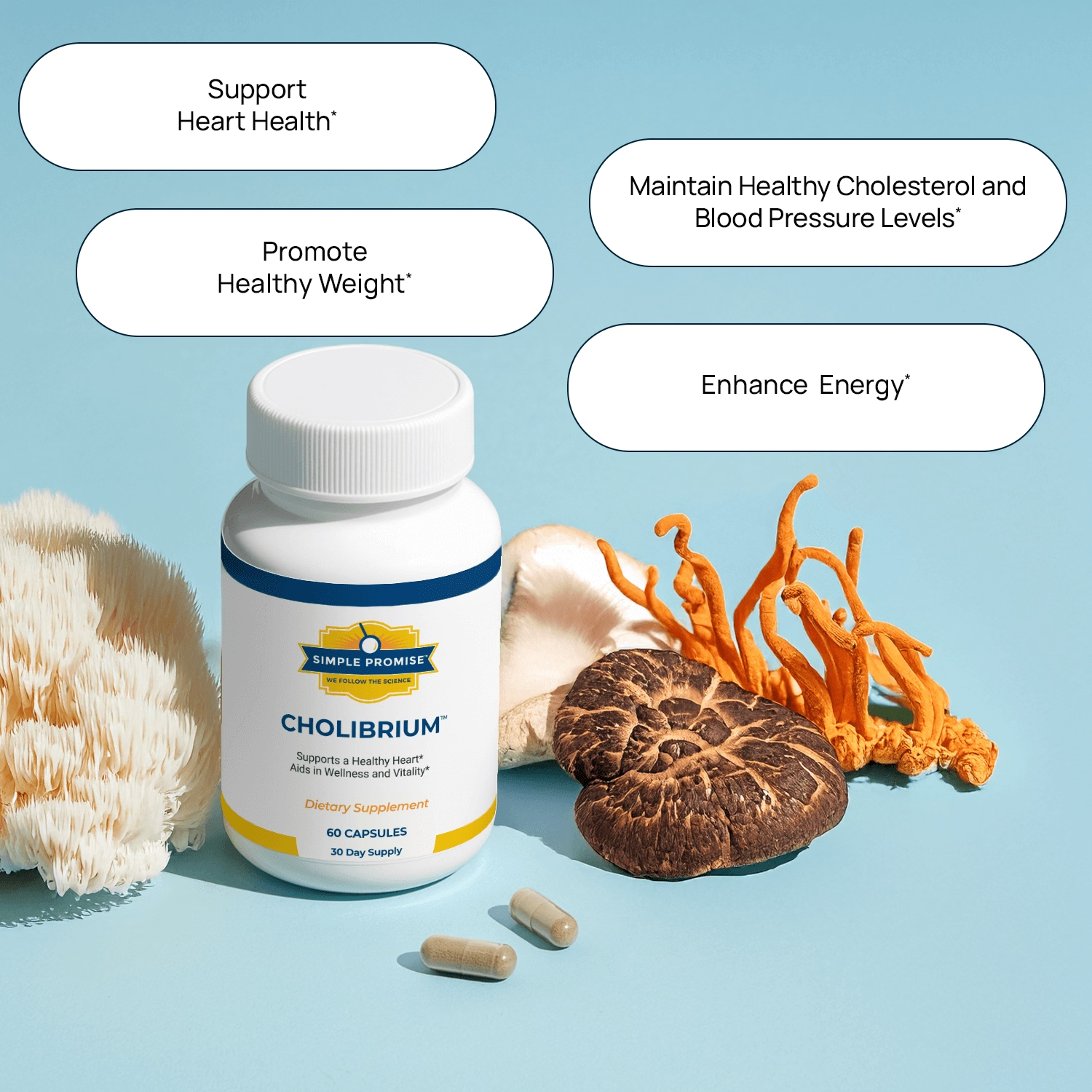
What we like
- Supplement Facts panel published, with doses for four of the ten mushrooms
- 365-day money-back guarantee
- Lower price than many ClickBank supplements, from $39 per bottle in the six-bottle kit
- No automatic billing, according to the brand
- Simple two-capsule daily serving
Watch out for
- Reishi did not improve cholesterol in a Cochrane review, even at 1.4 to 3 grams a day
- Six of ten mushrooms share a 266 mg proprietary blend with undisclosed amounts
- Doses are far below those used in most mushroom studies
- Chaga is high in oxalate, a concern for people with kidney stones
- Some affiliate ads make claims about clearing arteries that the evidence does not support
- Manufacturing country not stated on the sales page
What is Cholibrium?
Cholibrium is a capsule supplement sold under the Simple Promise brand through ClickBank. The sales page describes it as a heart and antioxidant support formula built around 10 mushroom extracts, and says it is designed to help maintain cholesterol levels that are already within a healthy range. Each bottle holds 60 capsules, and the suggested serving is two capsules a day, 20 to 30 minutes before a meal, so one bottle lasts 30 days.
Unlike many products in this category, Cholibrium does publish a Supplement Facts panel, which we found among the brand’s product images. It lists four mushrooms at 266 mg each (cordyceps mycelium powder, reishi, shiitake and lion’s mane) plus a 266 mg proprietary blend of six more: maitake, turkey tail, chaga, royal sun agaricus, white button mushroom and wood ear fungus. That adds up to about 1,330 mg of mushroom material per serving. Other ingredients are a vegetable capsule, microcrystalline cellulose and magnesium stearate.
How Cholibrium claims to work
The brand says the mushrooms work with the body’s natural processes to support cardiovascular function. The ingredient descriptions on the sales page make specific suggestions: that reishi may support HDL cholesterol and triglycerides, that shiitake contains eritadenine, a compound studied for cholesterol, that chaga may help maintain LDL cholesterol, and that white button mushroom and other species provide beta-glucans. Product images add claims about healthy weight, blood pressure and energy.
Some of the brand’s affiliate marketing materials go much further, with ad headlines about clearing arteries overnight. Nothing in the published research supports claims like that for any mushroom, and the official sales page itself sticks to softer “may support” language. We judged the product on its label and the evidence, not on the most aggressive ads.
It is also worth separating two ideas the marketing tends to blend together. Mushrooms are nutritious foods, and eating more of them as part of a plant-forward diet is reasonable advice. That is different from the claim that small amounts of concentrated extracts in a capsule will move cholesterol numbers. The second claim needs its own evidence, and for most of these species that evidence does not yet exist. No clinical trial has tested Cholibrium as a finished product.
What the ingredients actually do
The four disclosed mushrooms
Reishi is the ingredient most directly tied to the product’s heart claims, and it is also the one with the most sobering evidence. A Cochrane review of five trials found that reishi taken at 1.4 to 3 grams a day for 12 to 16 weeks did not meaningfully change total cholesterol, LDL cholesterol, triglycerides or blood pressure compared with placebo in people with type 2 diabetes (Klupp et al., 2015). Cholibrium provides 266 mg, well below those doses. See our reishi page.
Shiitake has one relevant small trial. In 68 adults with borderline high cholesterol, shiitake food bars eaten for 66 days lowered triglycerides by about 10% compared with placebo bars, but total and LDL cholesterol were not reported as improved, and about 10% of people in the shiitake group developed skin rashes (Spim et al., 2021). Those bars contained whole mushroom, not a 266 mg extract. More on our shiitake page.
Cordyceps and lion’s mane are not primarily heart ingredients. A small trial in healthy older adults found modest improvements in exercise thresholds with a cordyceps product at 333 mg three times a day (Chen et al., 2010), and lion’s mane has a small trial in mild cognitive impairment using 3 grams a day (Mori et al., 2009). Neither was studied for cholesterol in people, and Cholibrium’s doses are lower. See cordyceps and lion’s mane.
The proprietary blend
Six mushrooms share 266 mg, so each one averages roughly 44 mg, and the true split is unknown. Maitake, turkey tail, royal sun agaricus, white button mushroom and wood ear have mostly been studied in the lab, in animals, or in small human trials on immunity, allergy or cancer care, not on cholesterol. Chaga has almost no human trial data and is known to be very high in oxalate; case reports describe kidney damage in people who took large amounts of chaga powder for months (Kikuchi et al., 2014). At the small amount likely present here, that risk is probably low, but people with kidney stones or kidney disease should know about it.
What about beta-glucans?
The best-documented food fiber for LDL cholesterol is oat beta-glucan. A meta-analysis found that at least 3 grams a day lowered LDL by about 0.25 mmol/L, roughly 10 mg/dL (Whitehead et al., 2014). Mushroom beta-glucans are structurally different, and 1.3 grams of mixed mushroom extract cannot supply anything close to 3 grams of beta-glucan, so this research does not transfer to Cholibrium. The label also does not state a beta-glucan percentage for any of its extracts, which better mushroom products often do.
How the doses compare
Put simply, the four disclosed mushrooms are each present at roughly a tenth to a fifth of the amounts used in the human studies we found, and the six blended mushrooms are likely present at even smaller amounts. Spreading about 1.3 grams across ten species makes for an impressive-looking ingredient list, but it leaves little room for any single mushroom to reach a studied dose. This is a common trade-off in multi-ingredient formulas, and it is the main reason our evidence score is modest.
Who it may suit, and who should skip it
Cholibrium may appeal to adults who like the idea of a mushroom complex, already eat well and exercise, and want a low-commitment supplement with a long refund window. It is not a substitute for anything a doctor has prescribed. If your LDL cholesterol is high, lifestyle changes and, when appropriate, medication have far stronger evidence. Our topic page on borderline cholesterol on a checkup covers those steps.
Skip it or talk to your doctor first if you take blood thinners or antiplatelet drugs, diabetes medicines, blood pressure medicines or immune-suppressing drugs; if you have kidney stones or kidney disease (chaga); if you have liver disease (rare liver injury has been reported with reishi powders); if you are allergic to mushrooms; or if you are pregnant or breastfeeding, since safety data are lacking. Anyone scheduled for surgery should mention all supplements to the surgical team.
Price, guarantee and where to buy
On the official sales page at the time of our review, one bottle cost $59, three bottles cost $147 ($49 each) and six bottles cost $234 ($39 each), with free US shipping and no automatic billing. That makes Cholibrium cheaper than many ClickBank supplements, and the lowest per-bottle price is in line with mainstream mushroom blends. The brand offers a 365-day money-back guarantee; its FAQ says to send back the empty bottles for a refund. Buy only from the official website, since ClickBank is listed as the retailer and third-party listings may not honor the guarantee.
Our verdict
Cholibrium is more transparent than most products in its niche: you can see what is inside and how much of four of the ten ingredients you are getting. The problem is the evidence. The best-studied ingredient for heart markers, reishi, did not lower cholesterol in a Cochrane review even at doses five to ten times higher than this product provides, and the remaining mushrooms have little or no human cholesterol research. The year-long refund window and fair pricing soften the risk, but realistic expectations matter: this is a general mushroom supplement, not a proven cholesterol tool. We rate it 2.7 out of 5.
Ingredients and the evidence behind them
| Ingredient | Amount | Why it’s included | Evidence |
|---|---|---|---|
| Reishi Mushroom | 266 mg (extract, fruiting bodies) | Main heart-health ingredient in the formula; the brand says it may support HDL cholesterol and triglycerides. | Limited |
| Shiitake Mushroom | 266 mg (extract, fruiting bodies) | Included for cholesterol support; the brand points to its eritadenine and beta-glucan content. | Preliminary |
| Cordyceps | 266 mg (Cordyceps sinensis mycelium powder) | Included for oxygen use during exercise and general cardiovascular support, per the brand. | Preliminary |
| Lion's Mane | 266 mg (fruiting bodies) | Included for brain function; the brand also suggests it supports fat metabolism and triglycerides, which has not been tested in people. | Preliminary |
| Maitake Mushroom | Not disclosed (part of a 266 mg proprietary blend) | Part of the six-mushroom blend; the brand says it may support cholesterol and energy. | Preliminary |
| Turkey Tail | Not disclosed (part of a 266 mg proprietary blend) | Part of the six-mushroom blend; included as an antioxidant source, per the brand. | Limited |
| Chaga Mushroom | Not disclosed (part of a 266 mg proprietary blend) | Part of the six-mushroom blend; the brand says it may help maintain healthy LDL cholesterol. | Preliminary |
| Royal Sun Agaricus | Not disclosed (part of a 266 mg proprietary blend) | Part of the six-mushroom blend; the brand says its antioxidants may support cardiovascular health and blood pressure. | Preliminary |
| White Button Mushroom | Not disclosed (part of a 266 mg proprietary blend) | Part of the six-mushroom blend; the brand cites its beta-glucan content for cholesterol. | Preliminary |
| Wood Ear Fungus | Not disclosed (part of a 266 mg proprietary blend) | Part of the six-mushroom blend; the brand says its polysaccharides may support healthy blood and cardiovascular wellness. | Preliminary |
Each ingredient links to its own page with the research, typical doses and safety notes.
Side effects and who should avoid it
Mushroom extracts are usually well tolerated, but mild stomach upset, dry mouth and skin rash are possible. Shiitake can cause an itchy, whip-like rash in sensitive people, and rare liver injury has been reported with reishi powders. Chaga is very high in oxalate and has been linked to kidney damage in heavy, long-term users, so people with kidney stones or kidney disease should avoid this product or ask a doctor first. Mushrooms may interact with blood thinners, diabetes medicines, blood pressure medicines and immune-suppressing drugs. People who are pregnant, breastfeeding, allergic to mushrooms or scheduled for surgery should talk to their doctor before use.
FAQ
Does Cholibrium lower cholesterol?
There are no published studies on Cholibrium itself. Its main heart ingredient, reishi, did not lower total or LDL cholesterol in a Cochrane review of trials using 1.4 to 3 grams a day, much more than the 266 mg in this product. The other mushrooms have little human cholesterol research.
What is in Cholibrium?
Each two-capsule serving lists 266 mg each of cordyceps mycelium, reishi, shiitake and lion's mane, plus a 266 mg proprietary blend of maitake, turkey tail, chaga, royal sun agaricus, white button mushroom and wood ear fungus.
Can I take Cholibrium with a statin?
There is no specific interaction study, and Cholibrium should never replace a prescribed statin. Some mushrooms may affect blood sugar, blood pressure or clotting, so ask your doctor or pharmacist before combining it with any heart or diabetes medicine.
How much does Cholibrium cost?
At the time of our review, the official site charged $59 for one bottle, $147 for three and $234 for six, with free US shipping and no auto-billing.
What is the refund policy?
The brand offers a 365-day money-back guarantee. Its FAQ says to contact support and send back the empty bottles to receive a refund.
Sources
- Official Cholibrium website. Product details, label and pricing
- Ganoderma lucidum mushroom for the treatment of cardiovascular risk factors. Cochrane Database Syst Rev, 2015
- Effects of Shiitake Culinary-Medicinal Mushroom, Lentinus edodes (Agaricomycetes), Bars on Lipid and Antioxidant Profiles in Individuals with Borderline High Cholesterol: A Double-Blind Randomized Clinical Trial. Int J Med Mushrooms, 2021
- A prospective, randomized, double-blind, placebo-controlled study of the platelet and global hemostatic effects of Ganoderma lucidum (Ling-Zhi) in healthy volunteers. Anesth Analg, 2005
- Coriolus (Trametes) versicolor mushroom to reduce adverse effects from chemotherapy or radiotherapy in people with colorectal cancer. Cochrane Database Syst Rev, 2022