What we like
- Every ingredient and dose is disclosed on the label
- Maqui berry, gymnema, chromium and biotin are all at or near amounts used in human studies
- Chromium plus biotin dose mirrors a 447-person randomized trial
- 180-day money-back guarantee; opened bottles do not need to be returned
- As low as $39 per bottle in the six-bottle package
- Gluten-free, non-GMO, simple one-capsule daily routine
Watch out for
- "Blood Sugar Drain" kidney mechanism is marketing, not established science
- Maqui berry evidence comes from small studies, some without placebo and some industry-funded
- 2 mg of biotin can cause falsely high or low results on some lab tests
- 600 mcg chromium and gymnema may add to diabetes medicines and raise hypoglycemia risk
- Prices differ between the sales page and the MD/Process shop
What is GlucoBerry?
GlucoBerry is a once-daily capsule from MD/Process, a supplement company based in Atlanta, Georgia, whose label lists a distribution address in Aurora, Colorado. It is sold through ClickBank on the official GlucoBerry sales page and in the MD/Process online shop, and it is presented by Dr. Mark Weis, who is described as the formulator. Each bottle contains 30 capsules, a one-month supply.
We analyzed the official sales page, the shop page, the published supplement facts label, the refund policy and the research behind each ingredient. We did not test the product on people. GlucoBerry stands out in this category for one simple reason: it lists exactly four active ingredients, all with disclosed doses.
How GlucoBerry claims to work
The sales page centers on what it calls the “Blood Sugar Drain,” describing the kidneys as a drain that flushes excess sugar into the urine and claiming that a “sticky gray protein” clogs this drain in half of Americans. It says maqui berry helps dissolve that protein so the body can flush away excess sugar, and it cites Harvard and Johns Hopkins research to support the story.
That framing is much more confident than the evidence. The kidneys do reabsorb and excrete glucose, and some diabetes medicines (SGLT2 inhibitors) work there. But the human studies on maqui berry extract measured blood glucose, insulin and A1C, not kidney “clogs,” and the mechanism suggested in a 2014 study was inhibition of glucose transport in the small intestine in rodent tissue, not in the kidneys. We treat the “Blood Sugar Drain” as a marketing metaphor, not an established mechanism. The page also implies you can eat more of your favorite foods, which no supplement should encourage.
What the ingredients actually do
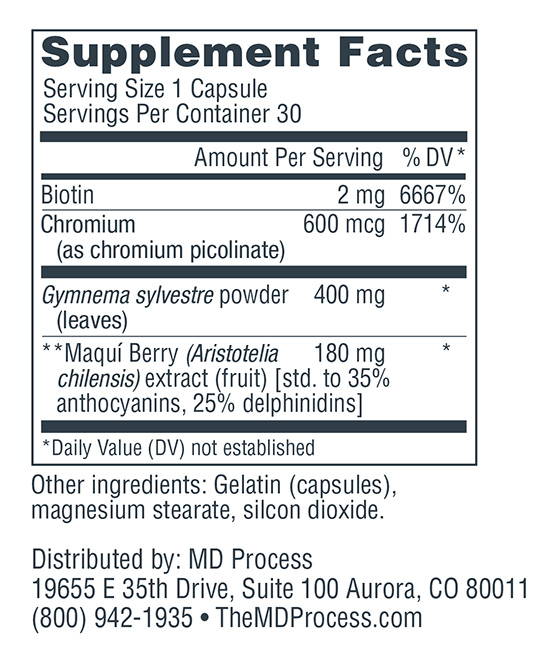
According to the supplement facts label, one capsule provides:
- Maqui berry extract, 180 mg, standardized to 35% anthocyanins and 25% delphinidins.
- Gymnema sylvestre leaf powder, 400 mg.
- Chromium, 600 mcg (as chromium picolinate), 1,714% of the Daily Value.
- Biotin, 2 mg, 6,667% of the Daily Value.
Maqui berry. The 180 mg dose and standardization match Delphinol, the branded maqui extract used in most human studies, although the label does not name the brand. In a three-month study of 31 people with newly identified moderate glucose intolerance, 180 mg daily was followed by a drop in average A1C from 5.65% to 5.35%, with improvements in LDL and HDL cholesterol. That study had no placebo group. A separate exploratory study in people with prediabetes found dose-dependent effects on glucose and insulin during glucose tolerance tests, and a small placebo-controlled crossover study in 10 volunteers found lower post-meal glucose after a rice meal. These are promising but small studies, and at least one was funded by an extract supplier. See our maqui berry page.
Gymnema. The 400 mg dose sits near the range used in research. A randomized, placebo-controlled trial in 30 adults with impaired glucose tolerance used 300 mg twice daily (600 mg total) and found lower two-hour glucose and A1C plus better insulin sensitivity after 12 weeks. A 2021 meta-analysis of 10 studies in type 2 diabetes was also positive but relied on before-and-after comparisons with high variability. More on gymnema.
Chromium and biotin. The 600 mcg chromium plus 2 mg biotin pairing copies a 90-day randomized, placebo-controlled trial in 447 people with poorly controlled type 2 diabetes who were already taking oral medicines. The combination lowered A1C by 0.54% and fasting glucose by about 10 mg/dL more than placebo, with the biggest effects in people with very high starting A1C. That population is very different from someone with normal or borderline readings. Separately, NCCIH describes the overall evidence for chromium as weak but suggestive of possible benefit for HbA1c, fasting glucose and insulin resistance in type 2 diabetes. See our pages on chromium and biotin.
Taken together, GlucoBerry is one of the few products in this category where every ingredient is present at or near a studied dose. That does not mean the formula has been tested as a whole, and the strongest single study behind it was done in people with diagnosed, poorly controlled diabetes on medication.
Who it may suit, and who should skip it
GlucoBerry may suit an adult whose doctor has said their glucose markers are drifting upward, who is already working on diet, activity and sleep, and who wants a transparent, simply dosed supplement to discuss with that doctor. It is not a substitute for diagnosis, monitoring or prescribed treatment.
Talk to your doctor before using it, or skip it, if you:
- Take insulin, sulfonylureas, metformin or other glucose-lowering drugs. Chromium and gymnema may add to their effect, and the Office of Dietary Supplements specifically warns that chromium with insulin or other diabetes medicines could increase the risk of low blood glucose (hypoglycemia).
- Have blood tests coming up. Two milligrams of biotin is enough to cause concern: the Office of Dietary Supplements and the FDA warn that high biotin intake can produce falsely high or low results on some thyroid, vitamin D and troponin tests. Tell your doctor and the lab, and ask whether to pause it beforehand.
- Take levothyroxine, since chromium picolinate taken at the same time may reduce its absorption.
- Have kidney or liver disease, or are pregnant or breastfeeding, given limited safety data for high-dose chromium and gymnema in these groups.
Price, guarantee and where to buy
Prices differ slightly between official channels. At the time of our review, the ClickBank sales page offered two bottles at $69 each ($138 plus $9.95 U.S. shipping), three bottles at $59 each ($177 plus $9.95 shipping) and six bottles at $39 each ($234 with free U.S. shipping). The MD/Process shop listed a single bottle at $59, three-month supplies at $49 per bottle and six-month supplies at $39 per bottle, with an optional subscribe-and-save plan. Check the final checkout total before paying.
The guarantee is the most generous we have seen in this group: 180 days. The refund policy says to return any remaining unopened bottles within 180 days of the order date (opened or empty bottles do not need to be returned) and that you pay return shipping. Buy only through the official MD/Process or GlucoBerry pages so the guarantee applies; copycat sites with similar names exist.
The label shows gluten-free, non-GMO and allergen-free badges, and the sales page displays badges for GMP manufacturing, an FDA-registered facility and U.S. manufacturing. The FAQ says each batch is tested for purity, but we did not find published third-party test results.
Our verdict
We rate GlucoBerry 3.8 out of 5, the highest in our blood sugar group so far. It discloses every dose, its four ingredients are all present at or near amounts used in human studies, the price drops to $39 per bottle in the six-bottle package, and the 180-day guarantee is unusually generous. It loses points because the “Blood Sugar Drain” story oversells small, partly industry-funded maqui studies, the strongest chromium and biotin data come from people with diagnosed diabetes on medication, and the high biotin dose can interfere with lab tests. If you choose to try it, do it with your doctor’s knowledge, keep monitoring your numbers, and never use it in place of diabetes care.
Ingredients and the evidence behind them
| Ingredient | Amount | Why it’s included | Evidence |
|---|---|---|---|
| Maqui berry | 180 mg (Aristotelia chilensis fruit extract, standardized to 35% anthocyanins and 25% delphinidins) | The headline ingredient, matching the dose and standardization of the Delphinol extract studied for post-meal glucose and A1C. | Limited |
| Gymnema | 400 mg (Gymnema sylvestre leaf powder) | A traditional blood sugar herb included at a dose in the range used in human studies. | Limited |
| Chromium | 600 mcg (as chromium picolinate), 1,714% Daily Value | Included at the dose paired with biotin in a large trial in people with type 2 diabetes. | Moderate |
| Biotin | 2 mg (6,667% Daily Value) | Paired with chromium to mirror the chromium picolinate and biotin combination studied for glycemic control. | Limited |
Each ingredient links to its own page with the research, typical doses and safety notes.
Side effects and who should avoid it
GlucoBerry’s ingredients are generally well tolerated in studies, but they are active. Chromium and gymnema may lower blood glucose, and the NIH Office of Dietary Supplements warns that chromium combined with insulin or other diabetes medicines could increase the risk of hypoglycemia; watch for shakiness, sweating, hunger, dizziness or confusion and talk to your doctor before combining them. The 2 mg biotin dose can cause falsely high or low results on some lab tests, including thyroid, vitamin D and troponin tests, so tell your doctor and the lab before blood work. Chromium picolinate may reduce levothyroxine absorption if taken at the same time. Isolated case reports link high chromium intake to kidney, liver and muscle problems, and rare liver injury reports have involved gymnema-containing products. People who are pregnant or breastfeeding or who have kidney or liver disease should ask a doctor before use. Never use a supplement in place of diabetes treatment.
FAQ
What is in GlucoBerry?
Each capsule contains 180 mg of maqui berry extract (standardized to 35% anthocyanins and 25% delphinidins), 400 mg of gymnema sylvestre leaf powder, 600 mcg of chromium as chromium picolinate and 2 mg of biotin.
Is the "Blood Sugar Drain" real?
The kidneys do filter and reabsorb glucose, but the idea that a "sticky protein" clogs a blood sugar drain and that maqui berry dissolves it is not established. Human maqui studies measured blood glucose, insulin and A1C, and the proposed mechanism in one study involved glucose transport in the intestine.
Can I take GlucoBerry with metformin or insulin?
Only with your doctor's approval. Chromium and gymnema may add to the effect of diabetes medicines and raise the risk of low blood sugar. Never adjust prescribed medication on your own.
Why does biotin matter for blood tests?
High biotin intake can interfere with lab tests that use biotin-streptavidin technology, leading to falsely high or low results for thyroid hormones, vitamin D, troponin and others. Tell your clinician and lab that you take it.
How much does GlucoBerry cost?
At the time of review, the sales page listed two bottles for $138, three for $177 and six for $234, and the MD/Process shop listed a single bottle at $59. Prices change often.
What is the GlucoBerry guarantee?
MD/Process offers a 180-day money-back guarantee. Return any unopened bottles within 180 days of your order date; opened or empty bottles do not need to be sent back, and you pay return shipping.
Sources
- bloodsugarberry.com/cb
- themdprocess.com/shop/glucoberry
- bloodsugarberry.com/refund-policy.php
- themdprocess.com/global/img/nutrition-glucoberry.jpg
- pubmed.ncbi.nlm.nih.gov/27820958
- pubmed.ncbi.nlm.nih.gov/28025651
- pubmed.ncbi.nlm.nih.gov/24861886
- pubmed.ncbi.nlm.nih.gov/32460589
- pubmed.ncbi.nlm.nih.gov/34467577
- pubmed.ncbi.nlm.nih.gov/39666848
- pubmed.ncbi.nlm.nih.gov/17506119
- ods.od.nih.gov/factsheets/Chromium-HealthProfessional
- nccih.nih.gov/health/diabetes-and-dietary-supplements
- ods.od.nih.gov/factsheets/Biotin-HealthProfessional
- fda.gov/medical-devices/in-vitro-diagnostics/biotin-interference-troponin-lab-tests-assays-subject-biotin-interference
- niddk.nih.gov/health-information/diabetes/overview/preventing-problems/low-blood-glucose-hypoglycemia