What is bentonite clay?
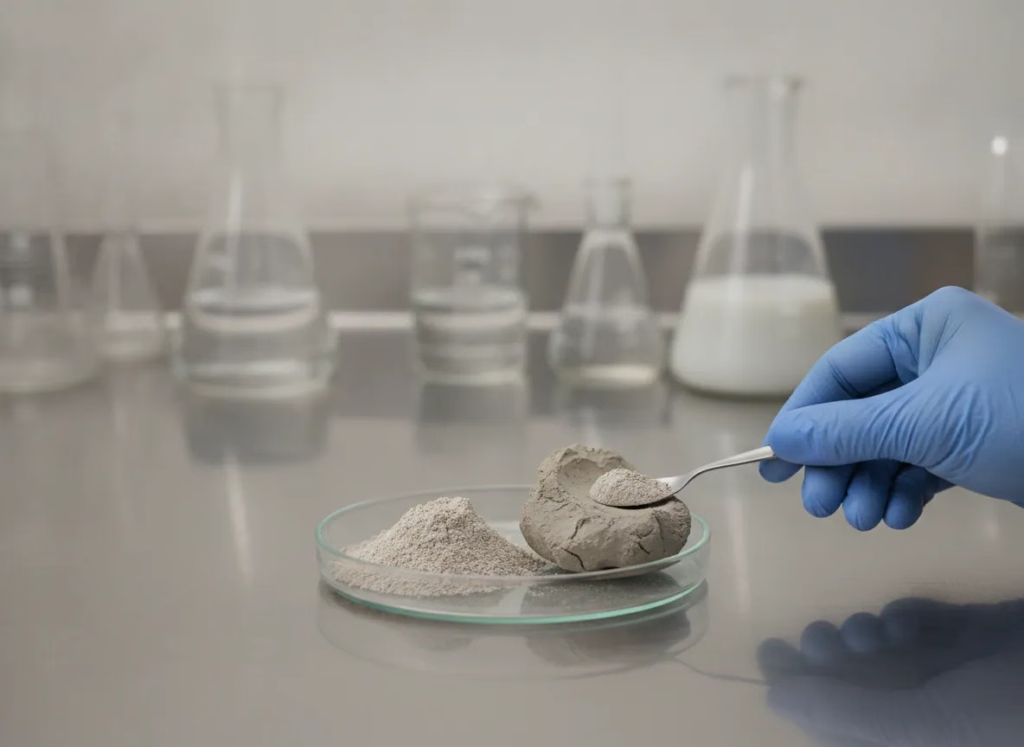
Bentonite is a clay formed from weathered volcanic ash. Its main mineral is montmorillonite, an aluminum and magnesium silicate with a layered structure that can bind water and some other molecules. That binding property is why it is sold as a “detox” ingredient, and why some purified clays are used as anti-diarrheal medicines in other countries.
What the research says
The best human evidence comes from a purified pharmaceutical form called beidellitic montmorillonite. In a 2005 multicenter, double-blind trial of 524 people with IBS, 3 g three times a day for eight weeks did not significantly beat placebo in the overall group (51.7% vs 45.2% success). In the constipation-predominant subgroup, however, abdominal pain or discomfort improved in 49.4% versus 31.5% on placebo. Stool frequency did not change. Tolerance was good. This was a regulated drug product at a specific dose, not a supplement.
Lab and animal studies show clays can adsorb toxins, fats and microbes in the gut, but we found no rigorous human evidence that bentonite in a dietary supplement “cleanses” the intestines, removes parasites or improves regularity. Claims that it does are marketing, not established science.
Contamination is a real concern. Researchers at the National Institute of Environmental Health Sciences reported in a 2020 study that samples of a therapeutic “healing clay” contained high concentrations of arsenic and lead. Because clays come from the ground, their heavy metal content depends heavily on the source and on testing.
How it’s used in supplements
Bentonite appears in digestive capsules in undisclosed amounts, usually alongside fibers. Because clay can bind other substances, it may also reduce the absorption of medicines and nutrients taken at the same time. If a product contains bentonite, look for independent heavy-metal testing (a certificate of analysis), take it apart from any medication, and skip it during pregnancy, while breastfeeding and for children unless a doctor advises otherwise.
It is also worth separating bentonite from the claims made around it. “Detox” marketing often says clay pulls toxins, heavy metals or parasites out of the gut. The body already clears waste through the liver, kidneys and bowel, and we found no controlled human trials showing that an oral clay supplement improves those processes in healthy people. Most of the mechanistic support comes from laboratory and animal work, which cannot tell us what a few hundred milligrams in a capsule will do in a person.
Finally, note that the IBS trial used a pharmaceutical product manufactured to drug standards, with a defined mineral composition. Bentonite sold as a supplement ingredient can vary in mineral type, purity and contaminant levels from one source to the next. Without a published certificate of analysis, a consumer has no way to know which kind is in the bottle.
Can you eat bentonite clay?
Food-grade bentonite exists, but that label is narrower than it sounds. The FDA affirms bentonite as generally recognized as safe only as a processing aid, for example to clarify liquids, under conditions that leave “no significant residue” in the final food (21 CFR 184.1155). That status does not mean eating spoonfuls of clay is safe, and the FDA has not approved bentonite to treat or “detox” anything.
Contamination is the bigger issue. In 2016 the FDA told consumers not to buy or use “Bentonite Me Baby,” a bentonite clay whose label said it could be taken by mouth, after FDA laboratory testing found elevated lead levels. The agency advised anyone who had used it, or given it to a child, to see a health professional (FDA consumer warning, 2016). Lead exposure is a particular concern for children and during pregnancy, which is why clay products marketed for internal use deserve extra caution.
If you still choose a bentonite product, look for an independent certificate of analysis that reports lead, arsenic, cadmium and mercury, and avoid products sold for babies or children.
Bentonite clay, electrolytes and medications
The same binding ability that is marketed as “detox” can pull useful substances out of the gut as well. Two documented problems:
- Low potassium. A 3-year-old given colloidal bentonite by mouth and rectally for constipation arrived at the hospital with a potassium level of 0.9 mmol/L, a dangerously low value, and recovered after the clay was stopped and potassium was replaced (Bennett and Stryjewski, 2006). A pregnant woman who ate large amounts of clay developed severe muscle weakness from a potassium of 1.5 mEq/L (Ukaonu et al., 2003).
- Medication absorption. Clay can bind drugs and nutrients taken at the same time, so they may not absorb fully. Separate any clay product from medicines, thyroid hormone, birth control pills, iron and other supplements by at least 2 hours, and ask your pharmacist about your specific medicines.
Large amounts can also cause constipation or, rarely, intestinal blockage, especially without enough fluid.
Who should avoid bentonite clay?
- Pregnant or breastfeeding women
- Infants and children
- Anyone taking daily prescription medicines, unless a doctor or pharmacist approves the timing
- People with kidney disease, low potassium, or a history of bowel obstruction or severe constipation
If your real goal is regularity, fiber has much stronger evidence: see psyllium, our explainer on soluble vs insoluble fiber, and the topic page on sluggish, irregular bowel movements. Talk to your doctor before starting any clay supplement.
Frequently asked questions
Can you eat bentonite clay?
It is not recommended as a routine supplement. The FDA recognizes bentonite as safe only as a food processing aid that leaves no significant residue, not as something to eat by the spoonful. Clays can contain lead and arsenic, and the FDA has warned about bentonite products with elevated lead. Talk to your doctor before ingesting any clay.
What are the benefits of bentonite clay?
Proven benefits from supplement-grade bentonite are lacking. The best human data come from a purified pharmaceutical montmorillonite that eased abdominal pain in a constipation-predominant IBS subgroup but did not beat placebo overall. Lab and animal studies show clays bind toxins, but there is no rigorous evidence that oral bentonite detoxifies healthy people.
Does bentonite clay detox your body?
There is no good human evidence that it does. Clay can bind some substances in the gut, but your liver, kidneys and bowel already remove waste, and no controlled trials show oral bentonite improves that in healthy people. Ironically, some clay products have been found to contain lead and arsenic, adding to toxic exposure.
Does bentonite clay contain lead?
It can. Clays are mined from the ground and may contain lead, arsenic and other heavy metals depending on the source. In 2016 the FDA warned consumers not to use a bentonite clay product labeled for ingestion after its testing found elevated lead. A 2020 NIH study also found high arsenic and lead in a healing clay.
Does bentonite clay interfere with medications?
It may. Because clay binds substances in the gut, it can reduce how well medicines and nutrients are absorbed if taken at the same time. Take any clay product at least 2 hours apart from medications and supplements, and check with your pharmacist, especially for thyroid hormone, birth control, heart or seizure medicines.
Is bentonite clay safe during pregnancy?
No, it is best avoided. Clay products may contain lead, and eating clay has caused dangerously low potassium and muscle weakness in a pregnant woman. If you crave clay or other non-food items during pregnancy, tell your doctor, since it can be linked to iron deficiency.
What are the side effects of eating bentonite clay?
Possible side effects include constipation, bloating and, with large amounts, intestinal blockage. Clay can bind potassium and other minerals, and case reports describe severe low potassium after heavy use. It may reduce absorption of medicines and carries a risk of heavy metal exposure. Stop it and see a doctor if you feel weak or have severe constipation.
Safety and cautions
May contain heavy metals such as lead or arsenic depending on source; ask for third-party testing. Can bind and reduce absorption of medicines and nutrients; take at least 2 hours apart. Can cause constipation. Avoid in pregnancy, breastfeeding and children without medical advice.
Supplements we reviewed that contain it
★★★☆☆
Gut Vita reviewGut Vita is a one-capsule-a-day digestive blend of nine fibers and cleanse ingredients plus four unnamed probiotic strains. Several fibers a...
★★★☆☆
SynoGut reviewSynoGut is a ten-ingredient digestive capsule combining psyllium, flaxseed, prune, oat, apple pectin, glucomannan, aloe, bentonite clay, bla...
Reader reviews
No reader reviews yet. If you have tried Bentonite clay, you can be the first to share how it went.
Reader reviews are personal opinions from visitors. We do not verify purchases, and reviews are not medical advice. We publish positive and negative reviews alike; see our review guidelines.
Write a review
Sources
- Symptomatic efficacy of beidellitic montmorillonite in irritable bowel syndrome: a randomized, controlled trial. Aliment Pharmacol Ther, 2005
- Elevated Arsenic and Lead Concentrations in Natural Healing Clay Applied Topically as a Treatment for Ulcerative Dermatitis in Mice. J Am Assoc Lab Anim Sci, 2020
- 21 CFR 184.1155 — Bentonite.. eCFR
- FDA warning on Bentonite Me Baby clay (in Spanish). U.S. FDA
- Severe hypokalemia caused by oral and rectal administration of bentonite in a pediatric patient. Pediatr Emerg Care, 2006
- Hypokalemic myopathy in pregnancy caused by clay ingestion. Obstet Gynecol, 2003